
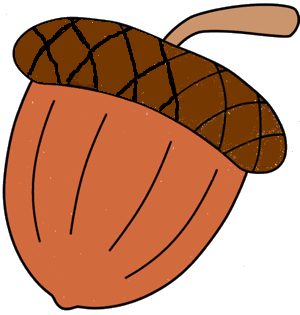
Definition: acorn
 the nut of the oak tree usually seated in or surrounded by a hard woody cupule
Fun Facts
1. An acorn is a nut produced by an oak tree. A mature white oak tree (Quercus alba) typically produces
an average of 3,000 to 8,000 acorns annually. But, like all oak trees, the white acorn tree experiences
something called a "mast year" every 2 - 5 years. During a mast year the tree may produce sometimes
tens of thousands of acorns!
2. The life cycle of an acorn starts when it falls from an oak tree in autumn. If it lands in a spot with good
soil and moisture, it can grow into a new tree! A white oak tree (Quercus alba) typically takes about 50
to 80 years to reach maturity.
3. Because oak trees can live for hundreds of years, in ancient times, acorns were thought of as
symbols of strength and endurance. In Norse mythology the oak tree was sacred to the god Thor.
4. Humans can eat acorns, but only if they are properly prepared first by removing the tannins contained
in the nut., which are bitter and can be toxic or irritating to the digestive system if consumed in large
amounts. Yet acorns are a cornerstone of forest ecosystems, acting as a vital food resources, supporting
wildlife populations, enabling new tree growth, and maintaining overall ecological balance.
5. Do children with food allergies need to be careful not to be around acorns? No. You can hold them, touch
them, just don't EAT them!
6. The tallest recorded oak tree was a white oak (Quercus alba) located in the United States. It reached
approximately 160 feet (about 49 meters) in height.
7. North America has the largest number of oak species, with approximately 160 species in Mexico, and
about 90 species in the United States. The second greatest area of oak diversity is China, with approx-
imately 100 species.