
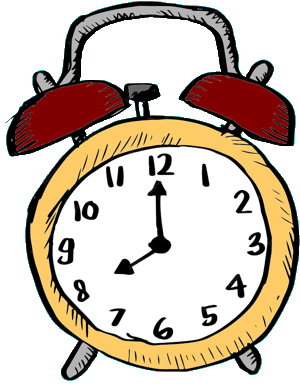
Definition: Analog Alarm Clock,
 An analog alarm clock is a traditional clock that uses mechanical
devices to keep time featuring an hour hand and a minute hand that move around a circular dial
with 12-hour markings.
Fun Facts
1. The word "alarm" originates from a medieval military battle cry. The word comes from the Old French phrase a l'arme (derived from the Italian all'arme), meaning "to arms!" In the 14th century, it meant a sudden signal or trumpet call alerting soldiers to wake up and prepare for defense!
2. Plato built an ancient water clock alarm to wake up his students. Around 400 BC, the Greek philosopher Plato designed a clepsydra (water clock). As water slowly filled a sealed vessel, air was forced through a narrow tube, creating a sharp whistling sound that acted as a hydraulic alarm for early morning lectures!
3. In Industrial Britain, human "knocker-uppers" acted as living alarm clocks. Before cheap mechanical clocks existed, workers hired knocker-uppers during the Industrial Revolution. These waking professionals used long bamboo poles or pea-shooters to tap on upper-story bedroom windows until workers woke up for factory shifts!
4. The first mechanical alarm clock in America could only ring at 4:00 AM. In 1787, American clockmaker Levi Hutchins invented the first mechanical alarm clock in New Hampshire. He built it solely for himself to ensure he woke up before sunrise at 4:00 AM every day, so he didn't include an adjustable setting!
5. The "snooze button" was engineered in 1956 with a fixed 9-minute delay. When Westclox introduced the first snooze alarm, clock gears were standardized around existing gear ratios. Adding a full 10-minute mechanical cycle was too complex, so engineers settled on approximately 9 minutes, establishing a global standard that persists today!
6. Digital LED clocks produce visible light using semiconductor electroluminescence. Digital alarm clocks use Light Emitting Diodes (LEDs) arranged in 7-segment digital displays. When electric current passes through semiconductor material, electrons jump energy gaps, releasing photons that illuminate the digits without burning hot filaments!
7. Quartz alarm clocks keep exact time using microscopic piezoelectric crystals. Modern battery-powered alarm clocks use a tiny piece of quartz crystal. When an electric voltage passes through, the crystal vibrates at an exact, predictable rate of 32,768 times per second (piezoelectricity), driving steady integrated circuits!