
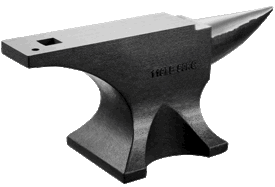
Definition: anvil
 An anvil is a heavy metal block with a flat top on which heated metal objects are hammered into shapes.
Fun Facts
1. The word "anvil" comes from an ancient Germanic phrase for forging metal. The name originates from the Old English term anfilte, which stems from Proto-Germanic *anafilti (combining *ana, "on", and *fellan, "to strike or beat"). It literally translates to "that upon which metal is beaten"!
2. Anvils work through Newton's third law of motion. When a blacksmith strikes glowing hot iron with a hammer, a high-quality forged steel anvil doesn't absorb the energy. Instead, its extreme density creates a strong rebound energy, bouncing the hammer back up and transferring force into the underside of the hot metal!
3. Anvils have a small bone in the human middle ear named after them. The human middle ear contains three tiny auditory ossicles that transmit sound vibrations: the malleus (hammer), the stapes (stirrup), and the incus (Latin for "anvil"). The incus sits in the middle, receiving mechanical vibrations from the hammer bone to pass to the inner ear!
4. The pointed cone on an anvil is called the "horn" or "bick." The smooth, unhardened conical projection at the front of an anvil is called the horn (or bickern). Blacksmiths use its rounded gradient to bend flat bars of heated iron into circular rings, curves, and curved horse shoes!
5. Traditional anvils were tested for quality using a high-pitched "ringing" tone. High-grade wrought iron and tool steel anvils produce a loud, high-frequency ringing sound when struck with a hammer, signaling a solid, crack-free crystalline structure. Blacksmiths often wrap heavy iron chains around the base to dampen the sound waves and protect their hearing!
6. Wyle E. Coyote's famous "ACME anvils" weighed hundreds of pounds. In classic Warner Bros. cartoons, characters dropped heavy anvils from high cliffs. In real life, a standard blacksmith's shop anvil weighs between 100 and 500 pounds (45 to 225 kg), while massive industrial power-hammer anvils can weigh over 100,000 pounds!
7. The earliest prehistoric anvils were made of hard stone block faces. Long before humans learned to forge bronze or iron around 3000 BC, Stone Age ancestors during the Paleolithic era used smooth, dense boulders of granite or basalt as stationary anvils to knap flint arrowheads, crush grains, and hammer raw copper ores!