
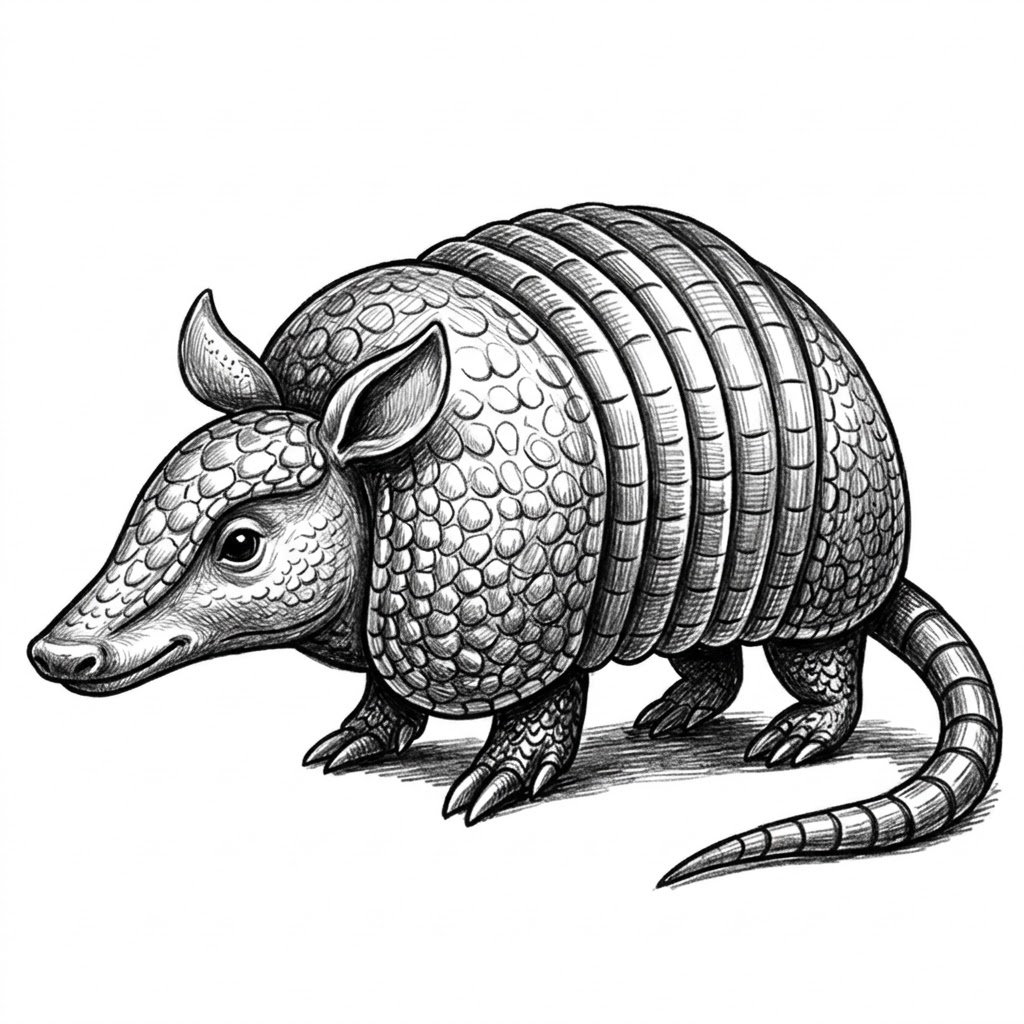
Definition: armadillo
 A armadillo a nocturnal omnivorous mammal that has large claws for digging and a body
covered in bony plates. Armadillos are native to the south central US and Central and South America.
Fun Facts
1. The word "armadillo" comes from Spanish for "little armored one." The word originates from the Spanish armadillo, which is the diminutive form of armado (meaning "armored man" or "armed one"). It directly describes the mammal's distinctive shield-like outer plating!
2. An armadillo's shell is made of real bone covered in keratin. Their protective carapace consists of osteoderms—bony plates that grow directly within the dermal skin layer. Overlaying these bony tiles are scales made of keratin, the exact same structural protein found in human fingernails and hair!
3. Only three-banded armadillos can roll into a completely sealed ball. Contrary to popular cartoons, most armadillo species cannot roll into a sphere because they have too many rigid body bands! Only the three-banded armadillo (Tolypeutes) has flexible skin joints that allow its head, tail, and shell plates to lock together into an armored ball.
4. Nine-banded armadillos always give birth to genetically identical quadruplets. The female nine-banded armadillo (Dasypus novemvinctus) undergoes polyembryony, where a single fertilized egg consistently splits into four separate embryos. This means every litter consists of four identical quadruplets of the exact same sex!
5. Armadillos can walk underwater by swallowing air to inflate their intestines. Because their heavy bony armor makes them dense, armadillos sink in deep water. To cross rivers, they can either sink to the bottom and walk across riverbeds while holding their breath for up to 6 minutes, or swallow air to inflate their digestive tract for buoyancy!
6. Armadillos are used in medical research because they can contract leprosy. Armadillos have a low core body temperature around 90∘F–95∘F (32∘C–35∘C), making them one of the few non-human mammals susceptible to Mycobacterium leprae, the slow-growing bacterium that causes Hansen's disease (leprosy).
7. Prehistoric armadillo relatives grew to the size of a modern Volkswagen Beetle. During the Pleistocene epoch, giant armadillo ancestors called Glyptodonts roamed North and South America. Weighing up to 4,000 pounds (1,800 kg), these massive herbivores sported solid dome shells and spiked club-like tails!