
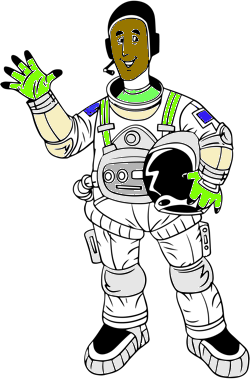
Definition: astronaut
 A astronaut is a person who is trained to travel in a spacecraft.
Fun Facts
1. The word "astronaut" literally means "star sailor" in Greek. The word originates from the Greek terms astron (meaning "star") and nautes (meaning "sailor"). It was coined in 1920 in science fiction before being officially adopted by NASA in 1958 to describe spacefarers!
2. Astronauts temporarily grow up to 2 inches taller in microgravity. Without gravity pulling down on the body, the fluid-filled cartilage discs between spine vertebrae decompress and expand. This process, called spinal elongation, makes astronauts grow up to 2 inches (5 cm) taller while living in orbit!
3. Spacesuits are miniature personalized human spacecraft. NASA’s Extravehicular Mobility Unit (EMU) suit weighs over 300 pounds (136 kg) on Earth. It provides a pressurized pure oxygen environment, thermal insulation, micrometeoroid shielding, and a closed-loop Sabatier reactor system to scrub carbon dioxide!
4. Astronauts lose bone density at a rate of 1% to 1.5% every month in space. Because microgravity eliminates weight-bearing stress on bones, the body absorbs mineral matrix faster than it builds new tissue. To combat osteopenia, astronauts exercise two hours daily using the ARED (Advanced Resistive Exercise Device), which uses vacuum cylinders to mimic heavy weights!
5. Astronauts on the ISS witness 16 sunrises and sunsets every single day. The International Space Station orbits Earth at roughly 17,500 mph (28,000 km/h). Because the station completes a full orbital revolution around the planet every 90 minutes, astronauts cross the sunlight-shadow terminator line 16 times per day!
6. Returning spacefarers experience "gravity sickness" as their vestibular system recalibrates. After months in orbit, the inner ear's otolith organs, which sense gravity and linear acceleration, adapt to microgravity. Upon returning to Earth, re-entering gravitational forces causes temporary space motion sickness, spatial disorientation, and balance loss!
7. Microgravity shifts body fluids upward, impairing taste bud sensitivity. On Earth, gravity pulls bodily fluids downward toward the feet. In microgravity, fluids redistribute toward the head (fluid shift), causing facial swelling and nasal congestion similar to a cold. This reduces olfactory senses, making astronauts crave spicy, bold foods!