
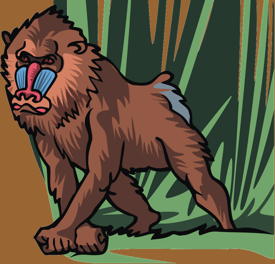
Definition: baboon
 A baboon is a large Old World ground-dwelling monkey with a long doglike snout, large teeth,
and naked callosities on the buttocks. Baboons are social animals and live in troops.
Fun Facts
1. The word "baboon" comes from an ancient French root for gaping or dribbling. The name originates from the Old French babouin (derived from baboue, meaning "grimace" or "dribbling mouth"). It shares etymological roots with the English word babble, describing their expressive facial chatter!
2. Baboons are Old World monkeys equipped with non-prehensile tails. Unlike New World monkeys of South America, baboons belong to the Cercopithecidae family (Old World monkeys). They cannot use their tails like an extra arm to grasp tree branches (non-prehensile tail); instead, they use their tails purely for balance while running!
3. Thick hairless butt pads called ischial callosities allow baboons to sleep sitting up. Baboons have hairless, toughened pads of skin on their rumps called ischial callosities. Attached directly to their pelvic bones, these callous pads act like built-in cushions, allowing baboons to sit comfortably on sharp rocks or high tree branches to avoid predators overnight!
4. Cheek pouches allow baboons to store food quickly to avoid competition. Baboons have flexible cheek pouches (buccal pouches) inside their mouths that extend down their necks. While foraging, they can cram as much food into these muscular pockets as their stomach can hold, allowing them to quickly store fruit and seeds before retreating to safety to chew!
5. Baboons are adaptable omnivores that hunt small animals and dig for tubers. While most monkeys eat fruit and leaves, baboons are opportunistic omnivores. Their diet includes seeds, grasses, insects, roots, and small mammals like rodents, birds, and young antelopes, allowing them to survive in deserts, savannas, and high mountains!
6. Baboon vocalizations include complex "wahoo" alarm calls that convey specific threat levels. Baboons communicate using a diverse acoustic repertoire including grunts, barks, and a loud two-syllable call known as a "wahoo". Biologists have found that the pitch, amplitude, and rhythm of these calls inform the troop whether a predator is on the ground or in the air!
7. Baboon social units form complex multi-male, multi-female troops governed by matriarchies. Baboon groups, called troops, can contain up to 300 individuals! While adult males move between troops, females remain in their natal group for life (female philopatry), forming stable matrilineal hierarchies where rank is inherited from mother to daughter!