
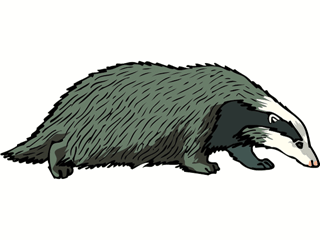
Definition: badger
 A badger is any of various burrowing mammals (especially Taxidea taxus and Meles meles) of
the weasel family that are widely distributed in the northern hemisphere.
Fun Facts
1. The word "badger" comes from a Middle English term describing a badge or mark. The name originates from the 16th-century Middle English term badge combined with the suffix -ard. It refers directly to the distinctive white facial stripe running down their dark snout, which resembles an identification badge!
2. Badgers construct underground subterranean fortresses called "setts." European badgers dig complex networks of underground tunnels and sleeping chambers known as setts. Some setts are centuries old, spanning hundreds of feet with dozens of entrance holes passed down and expanded through generations of badger families!
3. Honey badgers possess thick skin resistant to venomous snake bites and bee stings. The African honey badger (Mellivora capensis) has exceptionally thick, rubbery skin that sits loosely over its muscular frame. This allows it to twist around inside a predator's grip, while its immune system neutralizes dangerous neurotoxic snake venom!
4. Badgers belong to the Mustelidae family alongside otters, ferrets, and wolverines. Botanically and zoologically, badgers belong to the carnivorous mammal family Mustelidae. They share specialized anatomical traits with skunks and ferrets, including potent anal scent glands used to mark territory and communicate!
5. American badgers team up with coyotes to hunt ground squirrels. In a rare interspecies partnership called mutualistic hunting, American badgers (Taxidea taxus) pair up with coyotes! The badger digs into underground burrows to flush out prey, while the swift coyote catches rodents that try to bolt across open ground above!
6. A badger's sharp claws and robust forelimbs function as mechanical levers. Badgers are specialized fossorial (digging) mammals. Their shortened humerus bones and large sagittal crest on the skull provide powerful muscle anchor points, giving their foreclaws immense mechanical torque to slice through dense soil!
7. In Japanese folklore, the badger-like Tanuki is a mystical shape-shifting creature. In Japanese mythology, the Tanuki (Japanese raccoon dog, often translated as a badger) is celebrated as a mischievous spirit capable of metamorphosis. Statues of Tanuki traditionally hold a flask of sake and a promissory note representing prosperity and good fortune!