
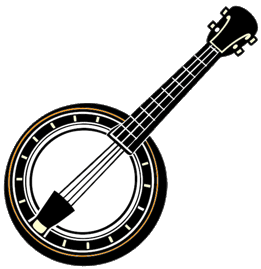
Definition: banjo
 A banjo a stringed musical instrument with a long neck and a round open-backed body consisting of parchment
stretched over a metal hoop like a tambourine, played by plucking or with a plectrum. It is used especially in American folk music.
Fun Facts
1. The word "banjo" trace its roots to West African languages. The name originates from West African terms such as mbanza or banjar in Kimbundu and Senegambian languages. Enslaved Africans brought these acoustic traditions to the Americas, where regional pronunciations evolved into the word banjo by the late 18th century!
2. A banjo is a hybrid instrument that is part string, part drum. Unlike guitars, which use a hollow wooden soundbox to project notes, a banjo’s body is a circular membrane chordophone. A stretched skin or plastic drumhead (vellum) sits inside a rigid wooden or brass rim, causing string vibrations to turn into acoustic sound waves instantly!
3. Early banjos were crafted out of dried gourds and animal hides. Before industrial metal rims were designed in the 19th century, traditional banjos were built using dried, hollowed-out gourds covered with stretched animal skins, featuring carved wooden necks and strings made from twisted animal gut or plant fibers!
4. A metal ring called a "tone ring" gives bluegrass banjos their piercing volume. Inside high-performance bluegrass banjos sits a heavy cast-bronze tone ring beneath the drumhead. This dense metal ring acts as an acoustic reflector, increasing mechanical vibration transfer to give the banjo its sharp, ringing attack and high acoustic amplitude!
5. Banjos use floating bridges held down solely by string tension. A banjo’s bridge is not glued down to the body like on a guitar! Instead, it is a floating bridge resting directly on top of the tight plastic drumhead, held firmly in place by downforce created by the tension of the tightened steel strings.
6. "Clawhammer" and "Scruggs style" are two completely different physical picking techniques. In traditional clawhammer style, the player strikes down with the back of the index or middle fingernail while catching the drone string with the thumb. In three-finger Scruggs style, players wear metal and plastic picks to rapidly pick upwards on individual strings!
7. Banjos play a major role in global folk and jazz traditions. Beyond Appalachian bluegrass and old-time music, 4-string tenor and plectrum banjos became key rhythm instruments in early 1920s Dixieland jazz and traditional Irish folk music due to their ability to cut clearly through brass bands without electric amplifiers!