
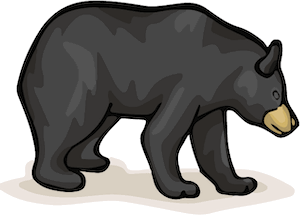
Definition: bear
 A bear is a large heavy mammal of the Americas and Eurasia that have long shaggy hair, short
tails, and plantigrade feet (walking on the sole with the heel touching the ground, like humans) with nonretractile
claws and that are mainly omnivorous but include some that are primarily carnivorous (as the polar bear) or herbivorous
(like the giant panda).
Fun Facts
1. Polar bears have black skin under their thick fur. Although polar bear fur looks bright white or yellowish, their individual hair shafts are actually clear and hollow. Sunlight reflects through the clear fur to make it look white, while their black skin beneath absorbs heat directly from the sun to keep them warm in freezing Arctic weather.
2. Bears don't sleep continuously through true winter hibernation. Unlike small mammals whose body temperatures drop near freezing, a hibernating bear's body temperature drops only slightly. Female bears even wake up during mid-winter hibernation to give birth to tiny cubs and nurse them inside their warm dens!
3. Sun bears have an extraordinarily long tongue. The sun bear, the smallest bear species in the world, has a flexible tongue that can stretch up to 10 inches (25 cm) long. This built-in tool lets them slurp up termites and reach deep into tree trunks for wild honey.
4. Giant pandas have a "pseudo-thumb" made of wrist bone. Pandas have five fingers plus an enlarged, modified wrist bone that acts just like an extra thumb. This special bone helps them grip tough bamboo stalks tightly while munching on up to 84 pounds of bamboo every day.
5. Bears are exceptionally fast runners. Despite their bulky appearance and heavy bodies, a grizzly bear can sprint up to 35 miles per hour (56 km/h)—fast enough to easily outrun the world's fastest human athletes!
6. Bears possess an extraordinary sense of smell. A bear's sense of smell is estimated to be seven times stronger than a bloodhound's and roughly 2,100 times stronger than a human's. They can detect the scent of food from over 20 miles away.
7. Grizzly bears use tree bark as a natural bulletin board. Bears rub their backs against tree trunks to scratch hitches, leave behind shed fur, and deposit scent markers that tell other nearby bears who visited the territory.