
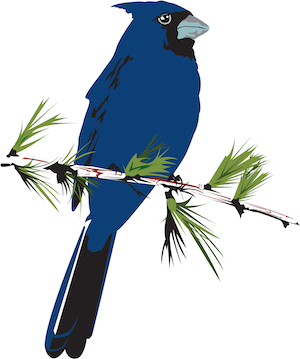
Definition: bird
 A bird is an animal with two wings, two feet, and a body covered with feathers. Most birds can fly.
Birds are warm-blooded animals with skeletons inside their bodies. Birds lay eggs with hard shells. Robins, eagles,
chickens, and ostriches are a few of the many kinds of birds.
Fun Facts
1. Hummingbirds can fly backward and upside down. Thanks to special wing joints that rotate in a figure-eight pattern, hummingbirds are the acrobats of the bird world. Their wings beat up to 80 times per second, creating a hum so fast it looks like a blur.
2. Owls can turn their heads almost all the way around. Because an owl's eyes are fixed in tubular sockets and cannot move side-to-side, they have 14 neck vertebrae (humans only have 7) allowing them to rotate their heads 270 degrees in either direction without moving their shoulders!
3. The Bee Hummingbird is the smallest bird in the world. Native to Cuba, this tiny bird weighs less than a U.S. penny and measures barely two inches long. Its tiny nest is about the size of a walnut shell!
4. Pigeons can recognize their own reflections in a mirror. Pigeons are remarkably intelligent and are among the very few non-mammal animal species that pass the "mirror test" for self-awareness. They can also recognize individual human faces and remember complex routes home from hundreds of miles away.
5. Woodpeckers have super-long tongues that wrap around their brains. To protect their brains from concussions while hammering into trees at high speeds, a woodpecker's tongue loops around the back of its skull inside its head to act as a natural shock absorber!
6. Crows and ravens make and use their own tools. Corvids (the crow family) are among the smartest creatures on Earth. They bend twigs into hooks to dig grubs out of tree bark, drop hard nuts onto crosswalks for cars to crush open, and even remember human faces for years.
7. Flamingos are born gray or white—they turn pink from their food. Flamingos get their signature bright pink color from pigments called carotenoids, which are found in the microscopic algae and brine shrimp they eat.