
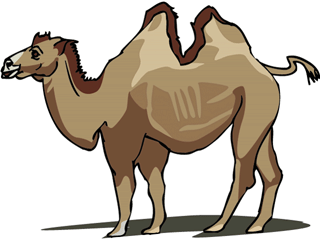
Definition: camel
 A camel is a large animal with long legs and a long neck. Camels are domesticated mammals;
people use camels for riding and for carrying loads across deserts. Camels from the deserts of Central Asia
have two humps. Camels from northern Africa and the Middle East have one hump.
Fun Facts
1. Camel humps store fat, not water! A common myth is that camels carry water in their humps, but they actually store fat. That stored fat gives them energy when food is hard to find in the desert, and it also keeps their bodies cool because all the fat isn't trapped under their skin!
2. They have built-in sunglasses and sand guards. Camels have three sets of eyelids to keep blowing sand out of their eyes! Two of those eyelids are see-through, acting like built-in safety goggles so they can still see while blinking during a sandstorm.
3. They can close their noses to block sand. When desert winds blow dust and sand everywhere, camels can snap their nostrils completely shut so no dust gets into their lungs.
4. Not all camels have two humps. There are two main types of camels! Dromedary camels live in the Middle East and Africa and have one hump, while Bactrian camels live in Central Asia, have two fluffy humps, and grow thick woolly coats for freezing winter snow.
5. They can drink massive amounts of water in minutes. When a thirsty camel finally finds an oasis, it can chug up to 40 gallons (150 liters) of water in just about 10 minutes—that is like drinking a whole bathtub full of water at once!
6. They can survive a long time without a drink. Because their bodies are so good at holding onto water and recycling moisture, camels can go for weeks without drinking any water when food is juicy and green.
7. Camel hooves act like giant snowshoes. Instead of sharp hooves, camels have wide, flat, leathery pads on the bottom of their feet. When they step down, these pads spread out so the camel doesn't sink into hot, slippery desert sand.