
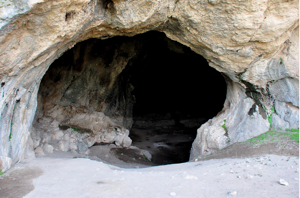
Definition: cave
 A cave is a natural, hollow hole in the ground, in a cliff, or on a hillside that is big enough for a person
to enter.
Fun Facts
1. Stalactites hold tight to the ceiling; stalagmites grow up from the ground. You can remember which is which with a simple trick: Stalactites hang clinging to the ceiling, while stalagmites grow from the ground! When a stalactite and a stalagmite meet in the middle, they fuse into a solid rock column.
2. The world's largest cave could fit a 40-story skyscraper inside. Hang Sơn Đoòng in Vietnam is so massive that it has its own underground rain forest, localized clouds, and a roaring river inside! Its largest chamber is over 600 feet high and more than 3 miles long.
3. Caves act as natural ancient time capsules. Because caves stay cool, dry, and sheltered from rain and wind, they preserve ancient artifacts for thousands of years. Early humans painted detailed prehistoric animal artwork on cave walls—like the famous Lascaux cave paintings in France, which are over 17,000 years old!
4. The Cave of the Crystals holds giant rock crystals bigger than trees. Located deep underground in Naica, Mexico, this unique cavern contains translucent selenite gypsum crystals measuring up to 38 feet long and weighing 55 tons! The cave stays scorching hot, so scientists must wear special cooling suits to explore it.
5. Most caves are carved out by acidic rainwater eating through limestone. Known as solutional caves, these subterranean chambers form over millions of years as rainwater absorbs carbon dioxide from the air and soil, turning into a weak acid that slowly dissolves underground limestone bedrock.
6. Baths of bat poop (guano) power entire cave ecosystems. Deep inside pitch-black caves where plants cannot grow, bats drop tons of nutrient-rich poop called guano. Microscopic bacteria and tiny insects feed on the guano, forming the primary base of the entire cave food chain!
7. Ice caves contain frozen glaciers that never melt, even in summer. High-altitude wind caves freeze water as cold air rushes through their narrow stone tunnels. Because rock walls act as thermal insulators, the thick blue ice inside remains permanently frozen year-round!