
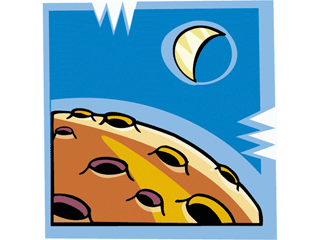
Definition: crater
 A crater is a hollow area shaped like the inside of a bowl. The mouth of a volcano is a crater,
and the moon has many craters on its surface.
Fun Facts
1. Two Different Kinds: Craters are formed in two main ways: either by giant space rocks crashing into a planet (impact craters) or by underground magma exploding and collapsing (volcanic craters).
2. Space Bomb Blasts: When a super-fast space rock hits a moon or planet, it doesn't just dig a hole—it explodes like a bomb, vaporizing rock and blasting out a giant bowl-shaped dent.
3. The Moon's Pockmarks: If you look at the Moon through binoculars, you'll see it is completely covered in craters. Because the Moon has no wind, rain, or weather, its craters never get erased!
4. Earth's Hidden Eraser: Earth gets hit by space rocks too, but wind, rain, oceans, and plants act like a giant natural eraser, slowly wearing down and hiding most of our old craters over millions of years.
5. From Tiny to Gigantic: Craters come in all sizes. Some are tiny enough to fit in your backyard, while others are massive basins hundreds of miles wide.
6. The Dinosaur Destroyer: Earth's most famous impact crater is the Chicxulub crater hidden underground in Mexico, which was formed by a giant asteroid 66 million years ago.
7. All Over the Solar System: Craters aren't just on Earth and the Moon—virtually every rocky world in our solar system, from Mars and Mercury to icy moons far away, is covered in them!