
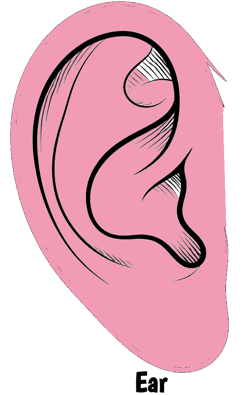
Definition: ear
 Ears are organs that detect and analyze sound. Located on each side of your head, they
help with hearing and balance.
Fun Facts
1. The smallest bones in your body are hidden inside your middle ear. Tucked behind your eardrum are three tiny bones called the hammer (malleus), anvil (incus), and stirrup (stapes). The stirrup bone is smaller than a single grain of rice!
2. Your ears control your sense of balance. Deep inside your inner ear are three fluid-filled loops called semicircular canals. As you move, tiny microscopic hairs inside the fluid sway like underwater plants, telling your brain exactly which way your head is tilting so you don't fall over!
3. Earwax is actually a specialized self-cleaning shield. Known scientifically as cerumen, earwax traps dirt, dust, and microscopic bugs before they reach your delicate eardrum. It also contains natural chemicals that prevent infections and keeps your ear canals from drying out and itching.
4. Your ears never stop working, even when you are fast asleep. While you sleep, your ears continue picking up every background sound around you. However, your brain acts as a filter, ignoring quiet, familiar noises so you can stay asleep, but instantly waking you up if it hears a loud or unusual sound!
5. Elephant ears act as built-in air conditioners. African elephants have huge ears packed with thousands of tiny blood vessels. On hot days, elephants flap their ears in the breeze to cool down the blood flowing through them, which then circulates through their body to drop their core temperature by up to 10 degrees.
6. Popping your ears on an airplane restores equal air pressure. When you fly high in a plane or drive up a mountain, the air pressure around you changes. Your ears equalize that pressure through a narrow tube connecting your ear to your throat (the Eustachian tube)—and swallowing or yawning opens that tube with a "pop!"
7. Snakes don't have outer ears, but they "hear" through their jawbones. Snakes lack visible ear openings or eardrums. Instead, their lower jawbone picks up vibrations traveling through the ground (like footsteps) and transmits those sound waves directly to their inner ear bones!