
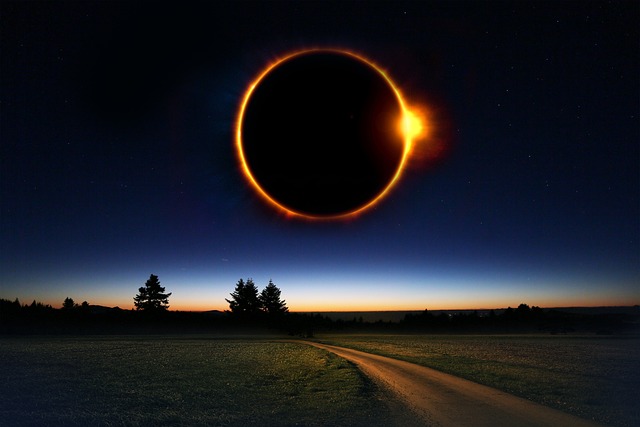
Definition: eclipse
 An eclipse is the blocking from view of the sun, a moon, or a planet by another heavenly body.
In an eclipse of the sun, the sun is hidden from earth's view by the moon passing between the sun and the earth.
Fun Facts
1. Cosmic Shadow Play: An eclipse happens when one space object—like a moon or a planet—moves directly into the shadow of another space object, blocking out the light!
2. Two Main Types: There are two famous types of eclipses we see from Earth: a solar eclipse (when the Moon blocks the Sun) and a lunar eclipse (when the Earth blocks the Sun's light from reaching the Moon).
3. The Sun's Fiery Ring: During a special kind of solar eclipse called an annular eclipse, the Moon is a little farther away from Earth, so it doesn't quite cover the whole Sun, leaving a glowing ring of light that looks like a "ring of fire."
4. Day Turning into Night: During a total solar eclipse, the Moon completely blocks the Sun's bright face for a few magical minutes, turning daytime into twilight, making the stars pop out, and dropping the outdoor temperature!
5. Safety First Glasses: You should never look directly at a regular or partial solar eclipse with your naked eyes because the bright sunlight can hurt your vision. You have to wear special, safe solar-viewing glasses!
6. Ancient Monster Myths: Long ago, before people understood science, ancient cultures made up wild stories to explain eclipses, like a giant celestial dragon, frog, or wolf trying to swallow the Sun or Moon whole!
7. A Rare Cosmic Alignment: Because the Moon, Earth, and Sun have to line up just right in a giant cosmic game of connect-the-dots, total solar eclipses only happen in any specific spot on Earth once every few hundred years!