
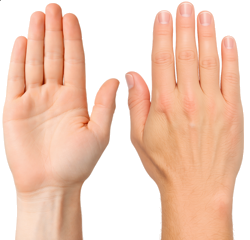
Definition: hand, pl hands
 A hand is the end part of a person's arm beyond the wrist, including
the palm, fingers, and thumb.
Fun Facts
1. More than one-quarter of all the bones in your body are in your hands. Each human hand contains 27 individual bones, 29 major joints, and at least 123 named ligaments! Together, your two hands house 54 bones—over a quarter of the 206 bones in your entire skeleton.
2. Your fingers don't actually have any muscles inside them. All the muscles that curl your fingers closed and pull them open are located in your forearm and palm! Long, thin tough cords called tendons run from your arm through your wrist like puppet strings to move your fingertips.
3. Fingerprints act like built-in tire treads for gripping objects. The tiny ridges on your fingertips, called dermal ridges, increase friction so smooth objects like glass bottles don't slide out of your hands. They also amplify microscopic vibrations when you touch textures!
4. Koalas have unique fingerprints that look almost identical to humans. Even under a powerful electron microscope, forensic scientists have trouble telling a human fingerprint apart from a koala's fingerprint! Chimpanzees and gorillas also have unique fingerprint whorls.
5. Your thumb is powered by 9 individual muscles. Opposable thumbs allow humans to touch the tip of the thumb to every other finger on the same hand. Controlled by 9 separate muscles and 3 major nerves, this unique setup gives humans both a super-strong "power grip" for swinging a hammer and a delicate "precision grip" for holding a needle.
6. Fingertips are packed with over 3,000 nerve receptors per square inch. Your fingertips are among the most sensitive touch organs on your body! They contain special receptors called Meissner's corpuscles that detect tiny vibrations and textures thinner than a single strand of hair.
7. Fingertips are packed with over 3,000 nerve receptors per square inch. Your fingertips are among the most sensitive touch organs on your body! They contain special receptors called Meissner's corpuscles that detect tiny vibrations and textures thinner than a single strand of hair.