
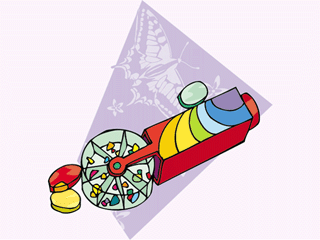
Definition: kaleidoscope
 A kaleidoscope is a tube with small bits of colored glass and mirrors inside. The tube is held
to the eye and turned to see changing forms.
Fun Facts
1. A Word That Means Magic: The word "kaleidoscope" comes from three ancient Greek words: kalos (meaning beautiful), eidos (meaning form), and skopeo (meaning to look at). Together, they literally mean "observer of beautiful forms"!
2. Invented by Accident: A Scottish scientist named Sir David Brewster invented the kaleidoscope in 1816 while doing science experiments with light and mirrors. He wasn't trying to make a toy, but everyone loved it instantly!
3. Mirror Magic Inside: A kaleidoscope is basically a cardboard or plastic tube lined with long, flat mirrors set at an angle to each other. When you look inside, the mirrors bounce light and reflections over and over again.
4. Endless Colorful Patterns: Because the mirrors reflect each other in a circle, even a few loose beads or bits of colored glass inside create symmetrical, star-like patterns that never repeat themselves—every single shake makes a totally brand-new design!
5. Victorian Super Craze: When kaleidoscopes first became popular in the 1800s during the Victorian era, people went completely wild for them. Millions of them were sold across Europe and America in just a few years!
6. Relaxing Brain Breaks: Looking into a kaleidoscope is so mesmerizing and peaceful that some people use them to help calm their minds, beat stress, and spark creative art ideas.
7. Easy DIY Craft: You can make your own simple kaleidoscope at home! All you need is a cardboard paper towel tube, three strips of shiny reflective mylar or plastic mirror sheets taped into a triangle, and some colorful plastic pieces trapped behind clear plastic wrap at the end.