
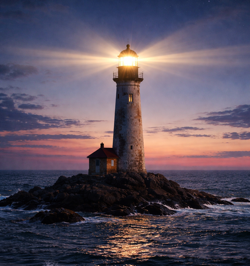
Definition: lighthouse
 A lighthouse is a tower with a flashing light for guiding ships and warning them of dangers
in the water.
Fun Facts
1. One of the Seven Wonders of the Ancient World was a lighthouse. Built around 280 BC in Egypt, the Lighthouse of Alexandria was over 300 feet tall! It used a giant fire at night and a massive mirror during the day to reflect sunlight up to 30 miles out to sea.
2. Special giant lenses bend light like magic. Most lighthouses use a Fresnel lens—a lightweight glass lens shaped like a giant beehive. It bends weak light into a super-concentrated beam that can shine through fog and rain for more than 20 miles.
3. Early lighthouse keepers burned whale oil and coal. Before electricity was invented, lighthouse keepers had to carry heavy buckets of lard, whale oil, or coal up hundreds of spiral stairs every night to keep the giant signal fires burning.
4. Lighthouse keepers had to wind them up like clockwork. To make the heavy glass lenses rotate, early lighthouses used a clockwork system powered by falling weights inside the tower. Keepers had to manually wind up the weights every few hours all night long!
5. The oldest working lighthouse is nearly 2,000 years old. The Tower of Hercules in Spain was built by the ancient Romans in the 1st century AD—and it is still standing and shining its light over the Atlantic Ocean today!
6. Robot technology replaced most lighthouse keepers. Almost all modern lighthouses are fully automated. They run on solar power, turn on automatically using sensors, and send health reports straight to computers on land without anyone needing to live inside the tower.
7. They can make noise when it’s too foggy to see. When thick ocean fog hides the light beam, lighthouses use giant foghorns, megaphones, or ringing bells to warn ships that dangerous rocks are nearby.