
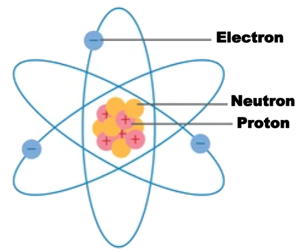
Definition: neutron
 A neutron is a small particle present in the nucleus of all atoms except the hydrogen
atom. Neutrons have no electrical charge. The mass of a neutron is about equal to the mass of a proton.
Fun Facts
1. What Is a Neutron?: A neutron is a tiny, subatomic particle that lives tightly packed together with protons right at the very center (the nucleus) of an atom.
2. The Neutral Peacemaker: Unlike protons that have a positive electrical charge and electrons that have a negative charge, neutrons have zero electrical charge—they are completely neutral, which means they don't attract or repel other particles.
3. Heavyweight Champions: Even though they don't have an electrical charge, neutrons are quite heavy for their size; they weigh almost the exact same amount as a proton!
4. The Atomic Glue: Neutrons play a super important superhero job inside atoms—they act like atomic glue! Because protons all have positive charges and naturally want to push each other away, neutrons step in between them to hold the nucleus tightly together.
5. The Lone Ranger Outside Atoms: If a neutron manages to escape from an atom's nucleus, it won't stay alone for long; it is unstable on its own and will transform into a proton and an electron in about 15 minutes!
6. Splitting Atoms with Neutrons: Because neutrons don't have an electrical charge, they can sneak right into the center of heavy atoms without being pushed away, which scientists use to split atoms and release huge amounts of energy in nuclear power plants.
7. Invisible to the Naked Eye: Neutrons are unimaginably tiny—so small that trillions of them could fit on the period at the end of this sentence, and you would need giant, high-tech particle accelerators just to study them!