
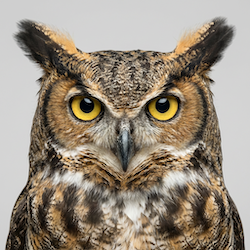
Definition: owl
 An owl is a bird that hunts for food at night. Owls have large eyes, strong legs, and sharp claws.
Fun Facts
1. They can turn their heads almost all the way around. Owls can rotate their necks up to 270 degrees! Because their eyes are locked into fixed sockets and can't roll around like human eyes, they have extra neck vertebrae and blood vessels to turn their whole head around safely.
2. Their feathers make zero noise when flying. An owl's flight feathers have soft, comb-like serrated edges that break up air turbulence into tiny micro-currents. This muffles the sound of flapping wings, allowing them to swoop down on prey completely unheard!
3. Their eyes are tube-shaped, not round balls. An owl's eyes aren't spherical light bulbs like ours; they are long, rigid eye tubes held in place by bony rings called sclerotic rings. This gives them incredible binocular vision to spot tiny mice far away in pitch darkness.
4. Their heart-shaped faces act like satellite dishes. Owls like the Barn Owl have a flat, heart-shaped face called a facial disc. The stiff feathers on the disc funnel soft rustling sounds straight into their ears, helping them hunt by sound alone!
5. Their ears are uneven on purpose. Many owl species have lopsided ear openings—one is placed higher on the skull than the other! This height difference lets them pinpoint the exact height and distance of a moving prey animal in fractions of a second.
6. A group of owls is called a "parliament." While a group of ducks is a flock, a collection of wild owls is officially named a parliament! This regal name comes from old folklore that viewed owls as wise, solemn judges.
7. They throw up "owl pellets" after dinner. Owls swallow small prey animals like mice and small birds whole! Because they can't digest bones, teeth, claws, or fur, their stomach compresses these leftovers into a dry ball called a pellet, which they cough back up later.