
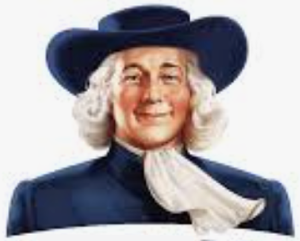
Definition: quaker
 A quaker is a member of the Religious Society of Friends, a Christian sect founded by George
Fox about 1650, whose central belief is the doctrine of the Inner Light. Quakers reject sacraments, ritual, and formal ministry,
hold meetings at which any member may speak, and have promoted many causes for social reform.
Fun Facts
1. They invented famous chocolate companies. In 19th-century England, Quaker families started major chocolate brands like Cadbury, Fry's, and Rowntree's! Because they didn't sell alcohol, they promoted sweet, alcohol-free chocolate drinks as a fun and healthy alternative for families.
2. Quaker Oats isn't actually run by Quakers. The famous man in black clothes on the Quaker Oats cereal box is a fictional character named "Larry." The cereal company chose the name "Quaker" in 1877 simply because the group was famous across America for honesty, fairness, and quality!
3. Traditional meetings are completely silent. In unprogrammed Quaker meetings, there are no priests, altars, or planned music! Everyone sits together in a quiet circle, waiting in silence until someone feels inspired to stand up and share a message.
4. They helped lead the Underground Railroad. Quakers were among the very first groups to oppose slavery in the 1600s and 1700s. Later in America, many Quakers built hidden rooms in their homes and acted as "conductors" to help enslaved people escape safely to freedom.
5. Pennsylvania was founded as a Quaker colony. In 1681, a Quaker named William Penn was given a huge piece of land by King Charles II of England. Penn established Pennsylvania as a peaceful sanctuary where people of any religion could live together without persecution!
6. They won a Nobel Peace Prize. In 1947, two Quaker organizations (the Friends Service Council and the American Friends Service Committee) were awarded the Nobel Peace Prize for helping victims of war, feeding hungry children, and rebuilding communities across Europe after World War I and II.
7. They don't use fancy titles. Quakers believe that everyone is equal, so historically they refused to bow, take off their hats for kings, or use fancy titles like "Your Highness" or "Sir." Instead, they addressed everyone—from peasants to royalty—simply by their first name or as "Friend."