
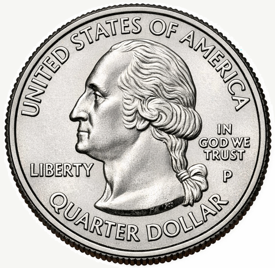
Definition: quarter
 A quarter is a coin of the United States and Canada. Four quarters are equal to one dollar.
A quarter is also equal to twenty-five cents..
Fun Facts
1. Because it takes 4 quarters to make a dollar, one such coin is called a quarter dollar, or simply a "quarter".
2. So why is a quarter also called two bits? In colonial times when the United States was still only 13 colonies there was a shortage of currency because Great Britain prohibited the American colonies from minting their own metal coins and severely restricted the shipment of British pounds across the Atlantic. This made trade difficult. But there was a Spanish coin called a "Real de Ocho" available to the colonists. The colonists would physically cut these coins into 8 small pieces called "bits." Two of those pieces equaled one-fourth of the coin—giving us the old nickname "two bits" for a quarter!
3. When the United States established its own national currency with the Coinage Act of 1792, it created the United States dollar based directly on the average weight and silver content of the Spanish dollars then in circulation. In fact, Spanish dollars remained legal tender in the U.S. all the way until 1857.
4. Now standard U.S. quarters intended for everyday circulation do not contain any silver. The Last Year for Silver Quarters was 1964 when quarters were made with 90% silver. Rising silver prices led the U.S. government to remove silver from quarters and dimes entirely. Beginning in 1965, circulating quarters switched to a "clad" composition made of an inner core of pure copper sandwiched between two outer layers of a copper-nickel alloy.
5. It costs 14.68 cents ($0.1468) for the U.S. Mint to manufacture and distribute a single non-silver circulating quarter. But the face value of a quarter is 25 cents. This means the the U.S. government makes a profit of 10.32 cents on every quarter produced!
6. Any standard U.S. quarter dated 1964 or earlier is made of 90% silver. Even if heavily worn, a single 1964-or-older quarter is worth roughly $4 to $5 based on its raw silver or "melt" value alone. Other quarters because of extreme historic rarity, or minting errors can be worth much more than just 25 cents. One example are quarters minted in 1932, the first year that George Washington appeared on the coin. These are 1932-D & 1932-S Washington Quarters. Only about 400,000 were struck at Denver ("D") and San Francisco ("S").
7.Mistakes made by machines at the U.S. Mint often slip into pocket change and drive up value. One example is the 2004-D Wisconsin State Quarter which has an "Extra Leaf" caused by machine error. In this case the machine made a stray mark on the coin which created an extra corn leaf on the design causing it to be worth $50 to $500. Why? Because collectors (hobyists) will pay this for coins in good condition. So, carefully look at your quarters before spending them!