
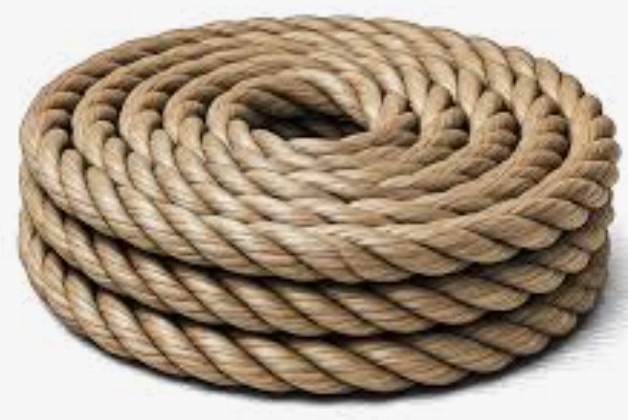
Definition: rope
 A rope is a strong cord of twisted or woven fiber, wire, or similar material. Ropes can be used to tie,
pull, or lift.
Fun Facts
1. Rope is made by twisting weak threads to make them strong. A single plant fiber or plastic thread tears easily on its own. But when hundreds of tiny fibers are twisted into yarns, and those yarns are twisted together in opposite directions, the friction locks them tightly into a super-strong rope!
2. Rope making is thousands of years old. Ancient Egyptians were making rope over 4,000 years ago using water reeds, grass, leather, and animal hair. They used giant ropes to pull heavy stone blocks to build the pyramids!
3. Inca bridges were built entirely out of woven grass rope. Ancient builders in South America woven massive cables out of wild grass to create suspension bridges across deep mountain canyons. One famous bridge, the Q’eswachaka in Peru, is still rebuilt by hand out of woven grass every single year!
4. Some modern ropes are stronger than steel. Synthetic ropes made from special materials like Kevlar or Dyneema can hold more weight than a steel cable of the exact same thickness—and they are light enough to float on water!
5. Sailors have special names for different ropes. On traditional sailing ships, sailors rarely used the word "rope." Instead, every line had a specific job name, like a halyard (used to raise the sails) or a sheet (used to control the sail angles).
6. Rope can stretch to save mountain climbers. Rock climbers use a special type called dynamic rope. It is designed to stretch like a giant rubber band when a climber falls, absorbing the shock so they don't get hurt when the rope catches them.
7. Magicians use "rope tricks" because rope is easy to hide in plain sight. In famous illusion shows, magicians use soft cotton ropes with magnetic tips, hidden inner wires, or special slippery knots to make ropes look like they are cutting in half and magically fusing back together!