
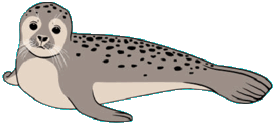
Definition: seal
 A seal is a mammal that spends most of its life in the ocean. Seals are a kind of pinniped, or mammal with
flippers instead of feet. Various kinds of seals live in both warm and cold parts of the world's oceans. A few kinds live in fresh
water. Seals are carnivores that eat fish and sea birds. They are closely related to sea lions and walruses.
Fun Facts
1. Seals can sleep completely underwater. When it's time for a nap, seals can sleep while floating under the surface! Their brains automatically trigger them to swim up, catch a breath of air, and sink back down without ever waking up.
2. Their whiskers are high-tech underwater radar. A seal's sensitive whiskers, called vibrissae, can detect tiny vibrations in the water left by swimming fish—allowing them to hunt for prey even in pitch-black ocean depths!
3. Seals and sea lions are easy to tell apart. "True seals" have tiny ear holes instead of external ear flaps, and they wiggle on their bellies like caterpillars to move on land! Sea lions have visible ear flaps and can rotate their flippers to "walk" on all fours.
4. Elephant seals can hold their breath for nearly two hours. Deep-diving elephant seals can hold their breath underwater for up to two hours and dive deeper than 5,000 feet down into the ocean—deeper than many military submarines!
5. A layer of blubber keeps seals warm in icy seas. Seals have a thick layer of fat called blubber under their skin. Blubber acts like a thick thermal jacket, trapping their body heat so they can swim comfortably in freezing polar waters.
6.Mother seals identify their pups by smell and sound. In crowded colonies with thousands of noisy seals on the beach, a mother seal knows her baby's unique voice and scent, allowing her to find her pup easily among hundreds of others!
7. Baby seals grow super fast on ultra-rich milk. Seal milk is incredibly rich—packed with up to 50% fat! Because the milk is so nutritious, harp seal pups can double their birth weight in just their first two weeks of life.