
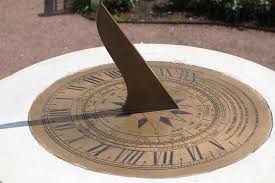
Definition: sundial
 A sundial is a device that stands in a garden or on a lawn to show the time of day.
A sundial has a flat, round disk with numbers and a pointer that casts a shadow. As the shadow moves
across the numbers, the sundial shows what time it is.
Fun Facts
1. The World's First Clocks: Long before mechanical clocks, digital watches, or smartphones were invented, ancient people used sundials as one of the very first ways to tell what time it was during the day!
2. Following the Sun: Sundials don't use gears or batteries. Instead, they tell time by using the position of the sun in the sky and the shadow it casts.
3. The Pointer (Gnomon): Every sundial has a special raised pointer called a gnomon (pronounced NOH-mon). As the sun moves across the sky from east to west, the gnomon acts like a finger, casting a shadow onto a flat plate marked with numbers.
4. Moving Shadows: As the day goes on, the shadow doesn't stay in one place. It slowly creeps around the dial, acting just like the hour hand on a regular clock face!
5. Outdoor Only: Sundials only work when the sun is shining! If it is a cloudy, rainy day or nighttime, the sundial can't cast a shadow, which means ancient people had to use water clocks or hourglasses when the weather was gloomy.
6. Facing North (or South): To work correctly, a sundial has to be set up just right. In the Northern Hemisphere (where North America and Europe are), the pointer has to tilt and point directly toward the North Star!
7. Garden Art Today: While we don't use them to catch the school bus or check bedtime anymore, sundials are still popular today as lovely, decorative ornaments found in gardens, parks, and schoolyards.