
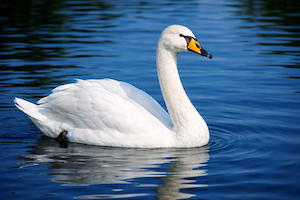
Definition: swan
 A swan is a large water bird, usually white, with a very long neck and webbed feet.
Fun Facts
1. Swans are among the largest flying birds in the world. Trumpeter swans can weigh up to 30 pounds and have a massive wingspan stretching over 8 feet across! Because they are so heavy, they need a long "runway" across the water, flapping their wings furiously to build up speed for takeoff.
2. They have more neck bones than a giraffe. While a human and a giraffe both have 7 neck vertebrae, a swan has 24 neck bones! Their super-flexible, S-shaped necks allow them to reach deep underwater to munch on aquatic plants without ever having to dive completely under.
3. Baby swans are called cygnets. Young swans aren't called chicks or ducklings—they are called cygnets! When they hatch, cygnets are covered in soft gray or brown fluff and often hitch a ride right on their parents' backs while swimming across lakes to stay safe and warm.
4. Swans mate for life. Once a male swan (a cob) and a female swan (a pen) choose each other, they usually stay together for their entire lives! When two swans face each other on the water, their curved necks often form the perfect shape of a heart.
5. Not all swans are white. While North American and European swans are famously white, Australia is home to the stunning Black Swan, which has midnight-black feathers with bright red beaks! There is also a South American species called the black-necked swan.
6. Swans defend their nests with powerful wing slaps. Swans are fiercely protective parents! If a predator or person gets too close to their nest, a swan will hiss loudly, puff out its feathers, and deliver powerful thumps using the hard, bony joints on their heavy wings to scare away intruders.
7. They sleep on one leg or floating in water. To keep warm and stay safe from land predators like foxes, swans often sleep while floating on the water! When resting on dry land, they tuck one leg up into their feathers to conserve body heat and rest their head tucked under a wing.