
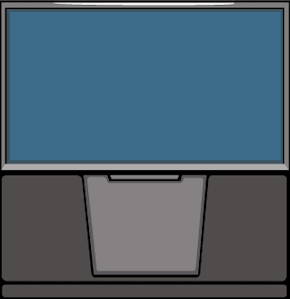
Definition: television
 television is the process of sending pictures and sound through the air as electrical
waves over distances to be seen on a screen. It is also an electronic device with a screen for receiving and
viewing such pictures.
Fun Facts
1. The word "television" means "vision from far away." The name comes from two different languages: tele (the ancient Greek word for "far off") and visio (the Latin word for "sight or vision")!
2. A 21-year-old farm boy invented the electronic television. In 1927, an American inventor named Philo Farnsworth figured out how to capture moving images using a beam of electrons. He got the idea while plowing a potato field in straight, parallel lines, which inspired him to scan images row by row onto a screen!
3. The first TV remote control was connected by a wire. In 1950, Zenith released the first television remote, appropriately named "Lazy Bones." It was connected directly to the TV set by a long, thick cable! Five years later, the "Flash-Matic" remote was invented, which used a beam of visible light aimed at light sensors on the TV's corners.
4. Every picture on your TV screen is made of millions of tiny dots called pixels. If you look very closely at a television screen, you won't see one big smooth picture—you'll see millions of microscopic squares called pixels. Each pixel lights up in combinations of just three basic colors: Red, Green, and Blue (RGB)!
5. Early televisions only showed black-and-white pictures. When TV broadcasting first became popular in the 1940s and 1950s, screens couldn't display color! Color television broadcasts didn't become widespread until the mid-1960s, starting with popular shows like The Wizard of Oz.
6. Old TVs were huge heavy boxes called CRTs. Before modern flat-screen TVs existed, televisions were giant, heavy wooden or plastic boxes powered by a Cathode Ray Tube (CRT). These deep glass tubes used an electron gun to shoot tiny particles against a glowing phosphor screen from the inside!
7. TV images trick your brain into seeing motion. Televisions don't actually show moving pictures! Instead, they flash 30 to 60 still photographs per second on the screen so quickly that your brain merges them together, creating the optical illusion of smooth movement (a phenomenon called persistence of vision).