
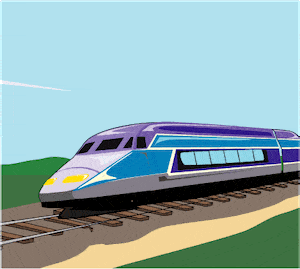
Definition: train
 Including an engine, a train is a connected series of railroad cars.
Fun Facts
1. The first trains were pulled by horses on wooden tracks. Long before steam engines were invented, people in the 1500s built wagonways with smooth wooden rails. Horses pulled heavy carts filled with coal and stone because wheels rolled much easier on wooden tracks than on bumpy dirt roads!
2. Steel wheels on steel rails create super-low friction. Why are trains so efficient at pulling massive weight? Steel train wheels rolling on steel tracks create almost zero rolling resistance compared to rubber tires on asphalt, allowing a single locomotive engine to haul hundreds of heavy cars at once!
3. Steam locomotives were powered by boiling water. Early steam engines burned coal or wood to boil water inside a large metal boiler. The expanding high-pressure steam was trapped inside cylinders, pushing heavy metal pistons back and forth to turn the giant driving wheels!
4. Maglev trains float on air using powerful magnets. Japan and China operate Maglev (magnetic levitation) trains that don't even touch the track! Superconducting electromagnets create magnetic repulsion to lift the entire train a few inches above the guideway, allowing it to glide smoothly at speeds over 300 mph without friction!
5. The Trans-Siberian Railway is the longest continuous train ride on Earth. The famous Trans-Siberian Railway in Russia stretches over 5,700 miles (9,200 kilometers) from Moscow to Vladivostok. A single non-stop trip across this massive railway takes nearly seven full days and crosses seven time zones!
6. George Stephenson is known as the "Father of Railways." In 1825, British engineer George Stephenson built the Locomotion No. 1, the world's first public steam railway locomotive to carry passengers. He also established the Standard Gauge track width (4 feet, 8.5 inches), which is still used across most of the world today!
7. Train whistles use coded signals to talk to workers. Train horns aren't blown just for fun—they follow a strict code! For example, two long blasts, one short blast, and one long blast (-- o -) is the universal safety pattern a train engineer MUST blow when approaching a road crossing.