
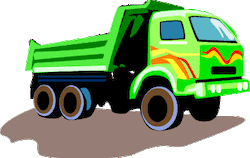
Definition: truck
 A truck is a large motor vehicle used for carrying heavy loads.
Fun Facts
1. The word "truck" comes from an ancient Greek word for a wooden wheel. The name originates from the Greek word trochos, which means "wheel." In the 1600s, sailors used the word truckle to describe the heavy wooden wheels under ship cannons, which eventually evolved into our modern word for heavy vehicles!
2. A "semi-truck" is named after its detachable trailer. Ever wonder why big rigs are called semi-trucks? The tractor unit pulls a semi-trailer, which is called "semi" because it only has wheels at the back! It cannot balance on its own and relies on the front tractor unit to support half its weight.
3.Semi-trucks use air brakes instead of hydraulic fluid. Unlike passenger cars that use liquid brake fluid, giant trucks use pneumatic air brakes. Powered by an engine compressor, compressed air fills heavy tanks—if a trailer accidentally disconnects, the air pressure drops instantly, forcing powerful safety springs to slam the brakes lock-tight!
4. Diesel engines generate massive torque to pull heavy cargo. Big trucks use diesel engines instead of gasoline engines. Diesel fuel detonates under extreme pressure rather than using spark plugs, which creates immense torque (rotational pulling force) allowing a big rig to tow up to 80,000 pounds of freight across mountain passes!
5. Big rigs can have up to 18 gears! Driving a heavy semi-truck requires lots of gear shifting to keep the engine in its power band. While standard cars have 6 to 8 automatic gears, large commercial trucks often feature manual transmissions with 10 to 18 distinct gear ratios split across high and low ranges!
6. Australian "Road Trains" can pull up to four trailers at once. In the vast, flat Australian Outback, truck drivers haul multiple cargo trailers chained together behind one powerful tractor unit. These massive vehicles are officially called Road Trains and can stretch up to 175 feet (53 meters) long!
7. Electric semi-trucks use regenerative braking to recharge while going downhill. Modern electric trucks use regenerative braking. When going down steep hills, the electric motors reverse their direction to act as generators—slowing the heavy truck down safely without overheating the physical brakes while converting kinetic energy back into battery power!