
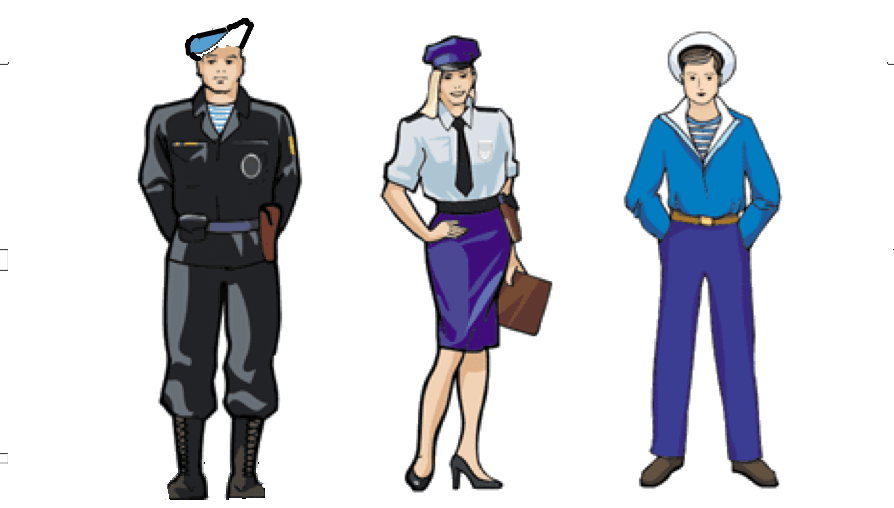
Definition: uniform
 A uniform is a distinctive suit of clothing worn by all members of a particular group,
like nurses, police, or soldiers.
Fun Facts
1. The word "uniform" means "one form." The word comes from two Latin roots: unus (meaning "one") and forma (meaning "form" or "shape"). Put them together, and it literally means everyone in a group wearing the exact same look!
2. The earliest school uniforms were created for charity. In 16th-century England, Christ's Hospital School established the world's first recorded school uniform in 1552. Students wore long, bright yellow stockings and blue trench coats—earning them the nickname "Bluecoat Schools"—so the community could easily identify and care for orphaned children!
3. Military uniforms switched to khaki and camouflage for optical safety. For hundreds of years, armies wore bright red, blue, or yellow coats so generals could spot their troops through dense cannon smoke. But as rifle technology improved, soldiers switched to khaki (a Persian word for "dust-colored") and camouflage to absorb light and blend in with surrounding terrain.
4. Firefighter suits use aramid fibers to block extreme thermal heat. Modern firefighter turnout gear is made from synthetic polymers like Nomex and Kevlar. These heat-resistant aramid fibers don't melt or drip when exposed to open flame, providing a thermal barrier that protects firefighters from temperatures over 1,000°F (537°C)!
5. Retroreflective stripes on work uniforms bounce light straight back to cars. Safety vests worn by construction workers use microscopic glass beads or prismatic polymers. Unlike normal flat surfaces that scatter light in all directions, these retroreflective materials reflect light waves directly back to a driver's headlights, making workers glow brightly at night!
6. Doctor white coats were adopted to show off sterile cleanliness. Before the late 1800s, doctors actually wore dark black suits to hide blood stains! Once scientists discovered germ theory and the importance of hygiene, medical staff switched to stark white coats so any dirt or contamination would show immediately, proving the clothing was freshly sanitized.
7. Chef uniforms use double-breasted jackets as a heat and stain shield. Traditional chef coats feature a thick, double-breasted front layer made of heavy cotton. This clever double layer acts as a heat insulator against hot stoves, and if the front gets stained with sauce, the chef can quickly flip the front flap over to look clean again!