
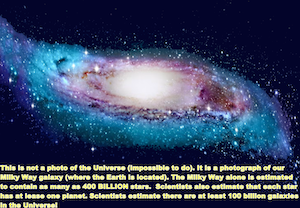
Definition: universe
 The universe is everything that exists, including the earth, the solar system, all the stars in space
and all of the planets that exist in orbit around those stars..
Fun Facts
1. The word "universe" comes from a Latin phrase for "turned into one." The word originates from the Latin term universum, combining unus ("one") and versus ("turned"). It literally describes all existing matter and space turned together into a single, grand cosmic whole!
2. The universe started roughly 13.8 billion years ago in the Big Bang. Everything in existence was once squeezed into an infinitely small, hot, dense point called a singularity. In a fraction of a second, this point expanded violently in an event known as the Big Bang, creating all time, space, and matter!
3. The observable universe spans an incredible 93 billion light-years across. Because space has been constantly expanding since the Big Bang, light from the most distant visible objects has taken billions of years to reach us. Today, scientists calculate the edge of the observable universe reaches about 46.5 billion light-years in every direction from Earth!
4. Space itself is expanding faster than the speed of light. The universe isn't just expanding into empty darkness—the very fabric of space is stretching out! Galaxies aren't flying away through space; instead, the physical distance between them is stretching, causing distant galaxies to move apart faster than light waves can travel.
5. There are more stars in the universe than grains of sand on Earth. Astronomers estimate that the observable universe contains over two trillion (2×10¹²) individual galaxies. With each galaxy hosting hundreds of billions of stars, the total number of stars outnumbers every grain of sand on every beach and desert across planet Earth!
6. Looking out into deep space means looking back in time. Because light travels at a finite speed of roughly 186,282 miles per second, light takes time to cross vast cosmic distances. When powerful observatories like the James Webb Space Telescope image galaxies 13 billion light-years away, we are seeing those galaxies exactly as they appeared 13 billion years ago!
7. Invisible dark matter and dark energy make up 95% of the cosmos. Everything we can see with our eyes and telescopes—stars, planets, gas clouds, and galaxies—makes up less than 5% of the total universe! The remaining 95% consists of invisible dark matter (which holds galaxies together) and mysterious dark energy (which accelerates cosmic expansion).