
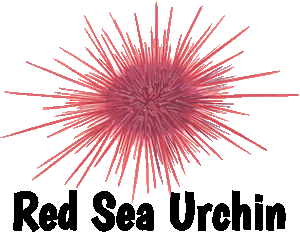
Definition: urchin
 A sea urchin is a marine invertebrate having movable projecting
spines on a roundish body; sea urchin.
Fun Facts
1. The word "urchin" is an old English name for hedgehogs. The name comes from the Old French word ourchon (derived from Latin ericius, meaning "hedgehog"). Because sea urchins look like round, prickly balls, ancient coastal dwellers called them "sea hedgehogs," which eventually became sea urchins!
2. Sea urchins move using thousands of tiny hydraulic "tube feet." Sea urchins don't have legs! Instead, they walk using hundreds of tiny, flexible tube feet protruding between their spines. These tube feet operate using a water vascular system, pumping seawater inside to create tiny hydraulic suction cups that grip rocks and pull the urchin along!
3. An urchin's sharp mouth mechanism is called "Aristotle's Lantern." Located on the underside of its body, a sea urchin's mouth features five sharp, beak-like teeth pointed inward. This complex jaw structure was named Aristotle's Lantern over 2,000 years ago because the ancient Greek philosopher Aristotle thought it resembled a five-sided horn lantern!
4. Red sea urchins can live for over 200 years. Scientists studying red sea urchins off the Pacific coast discovered that they show virtually no signs of aging! Using carbon-14 dating and growth ring measurements, marine biologists found some large specimens living in cold ocean waters were over 200 years old!
5. Sea urchins use shells and seaweed as sun umbrellas. Some urchin species use their tube feet to pick up small pebbles, empty seashells, or pieces of kelp and hold them over their tops. This behavior provides UV protection against bright sunlight in shallow tide pools and acts as natural camouflage from hungry seagulls!
6. Overpopulated urchin barrens can destroy entire kelp forests. Sea urchins love to eat giant kelp! If top predators like sea otters disappear, urchin populations explode into massive swarms that chew through the holdfasts of kelp plants, transforming thriving underwater kelp forests into barren, empty underwater deserts called urchin barrens.
7. Flower urchins store potent venom inside tiny snapping claws. While most sea urchin stings just poke like needles, the flower urchin (Toxopneustes pileolus) features small, flower-shaped pincers called pedicellariae between its spines. These pincers snap shut on touch and inject a powerful nerve toxin, making it the world's most dangerous sea urchin!