
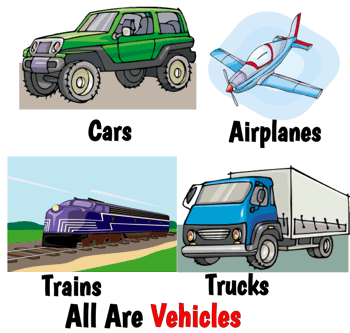
Definition: vehicle
 A vehicle is something used to carry and move people or things. Cars, buses,
and airplanes are vehicles.
Fun Facts
1. The word "vehicle" comes from a Latin word for carrying. The word originates from the Latin term vehiculum, which comes from vehere (meaning "to carry" or "to convey"). It describes any machine or device used to transport people or cargo from one place to another!
2. The wheel was invented around 3500 BC to build the earliest land vehicles. Before the invention of the wheel, humans hauled heavy loads using sledges pulled over logs. Ancient Mesopotamians mounted solid wooden wheels onto axles, creating the world's first horse- and ox-drawn carts!
3. Maglev trains float on air gaps using magnetic repulsion. Super-fast Maglev (magnetic levitation) trains don't have wheels touching tracks! Powerful superconducting electromagnets on the train and track repel each other, floating the train about 4 inches in the air to eliminate rolling friction and reach speeds over 370 mph (600 km/h).
4. Internal combustion engines power vehicles by exploding tiny gasoline droplets. Gasoline vehicles use an internal combustion engine where fuel and air mix inside cylinders. Spark plugs ignite the mixture, causing tiny controlled explosions that push pistons down and turn a crankshaft to rotate the wheels!
5. Hovercrafts travel over land and water using cushion air pressure. An amphibious hovercraft uses massive fans to force high-pressure air downward underneath its flexible rubber skirt. This creates a high-pressure air cushion that lifts the entire vehicle off the surface, letting it glide smoothly over water, mud, or flat land!
6. Airplanes generate upward lift using Bernoulli's principle. Airplane wings (called airfoils) are curved on top and flat on the bottom. As the plane moves forward, air flows faster over the curved top, creating lower pressure above the wing than below it. This pressure difference generates an upward force called lift that overcomes gravity!
7. The Apollo Lunar Roving Vehicle was unfolded on the Moon in 1971. The first vehicle driven on another celestial body was NASA's Lunar Roving Vehicle (LRV) during Apollo 15! Electric motors inside each wheel powered the buggy across lunar dust, using mesh steel tires instead of rubber because rubber would crack in the vacuum of space.