
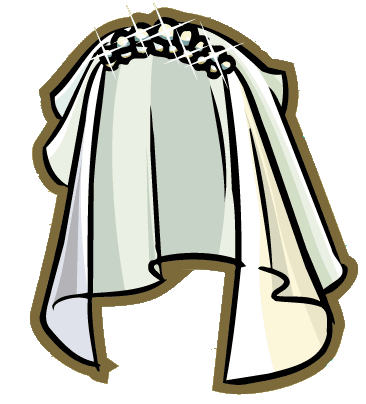
Definition: veil
 A veil is a thin piece of fabric or net worn over the face, head, or shoulders, or over some combination
of these. A veil is used as a decoration or to hide a person's face. Example: The bride wore a long white veil.
Fun Facts
1. The word "veil" comes from an ancient Latin word for a sail. The word originates from the Latin term velum, which means "a cloth, covering, or sail." It shares an etymological root with the canvas sails used to catch wind on ancient ships!
2. Ancient Romans wore bright yellow and red flame-colored veils. In ancient Rome, brides wore a distinctive veil called a flammeum. Dyed a vibrant flame-yellow or orange color, the veil was intended to mimic the glow of a fire flame to ward off evil spirits during wedding ceremonies!
3. Beekeepers wear mesh veils to protect themselves using optical scattering. A beekeeper's protective hat features fine black mesh cloth. Black thread absorbs light instead of reflecting it, creating a visual effect where bright sunlight doesn't glare into the beekeeper's eyes while keeping honeybees at a safe distance!
4. Tulle fabric gets its light weight from an open hexagonal mesh structure. Most modern veil cloth is made of a sheer net fabric called tulle, named after the French town of Tulle. Tulle is woven in a honeycomb pattern of tiny six-sided hexagons, creating a high strength-to-weight ratio that lets air and light pass right through!
5. Touareg men of the Sahara desert wear blue veils to block blowing sand. In the Sahara Desert, nomadic Berber men known as the Tuareg wear traditional indigo-dyed headcloth veils called tagelmust. The long cloth wraps around the head and face to filter out windblown desert dust and prevent skin dehydration!
6. The longest wedding veil in history stretched over 22,000 feet long. According to Guinness World Records, the world's longest wedding veil was created in Cyprus in 2018. It measured an incredible 22,843 feet (6,962 meters) long—enough sheer fabric to stretch across more than 63 football fields!
7. Microscopic silk fibers make traditional lace veils shimmering and smooth. Historic hand-knitted lace veils were crafted using fine silk threads harvested from silkworm cocoons. Silk fibers have a natural triangular prism-like protein structure that refracts incoming light at different angles, giving real silk veils a soft, natural shimmer!