
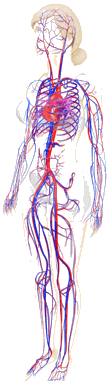
Definition: vein
 A vein is a small vessel that carries blood toward the heart.
Fun Facts
1. The word "vein" comes from an ancient Latin word for a water vessel or channel. The word originates from the Latin term vena, which means "blood vessel" or "water conduit." It stems from the Proto-Indo-European root wegh-, which means "to go, transport, or carry"!
2. Veins carry oxygen-depleted blood back to your heart. Unlike high-pressure arteries that carry fresh, oxygen-rich blood away from the heart to the rest of the body, most veins act as returning highways, carrying oxygen-poor blood and cellular waste products back toward the heart and lungs!
3. Veins contain tiny one-way valves to fight gravity. Because blood in your legs and lower body has to travel upward against gravity to reach your heart, veins feature tiny flap-like venous valves. These one-way valves snap shut after every heartbeat, preventing blood from flowing backward down your legs!
4. Your blood is never blue—veins only look blue because of physics. A common myth is that deoxygenated blood is blue, but human blood is always dark red! Veins look blue or purple through your skin because of an optical phenomenon: high-energy blue light reflects back to your eyes, while longer red light waves penetrate deeper into skin tissue.
5. Your calf muscles act as a secondary "muscle pump" for your veins. Every time you walk or jump, your calf muscles contract and squeeze against the deep veins in your legs. This mechanical compression acts like a skeletal muscle pump, physically squeezing blood upward toward your heart like toothpaste in a tube!
6. The body's largest vein is the vena cava. The largest vein in the human body is the inferior vena cava, measuring about 1 inch in diameter. It collects oxygen-depleted blood from your entire lower body—including your legs, abdomen, and organs—and dumps it directly into the right atrium of your heart.
7. Veins hold about 70% of all the blood in your body at any moment. Veins have thinner, more flexible walls than thick arteries, allowing them to stretch easily. Because of this high vascular capacitance, veins act as the body's primary blood reservoir, storing roughly two-thirds of your entire blood volume at rest!