
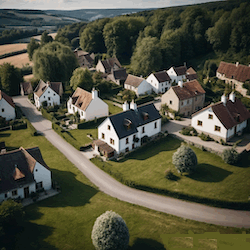
Definition: village
 A village is a small town or community, often in the country.
Fun Facts
1. The word "village" comes from an ancient Latin word for a farm estate. The word originates from the Latin term villaticus, which comes from villa (meaning "country house" or "farm estate"). It originally referred to the cluster of homes built around a central farming estate!
2. The Agricultural Revolution created the very first permanent villages. Before 10,000 BC, early humans were nomadic hunter-gatherers who moved constantly. When people discovered agriculture and plant domestication during the Neolithic Period, they built permanent homes near their crops, establishing the world's first agricultural villages!
3. Demographers define a village as having a population between 500 and 2,500 people. In geographical population hierarchies, a village is larger than a hamlet (a tiny cluster of houses with no church or shop) but smaller than a town. Villages typically range from a few hundred residents up to a couple thousand!
4. Circular "rundling" villages were designed in medieval times to protect livestock. In medieval Europe, Slavic and Germanic tribes built round settlements called rundlings. All the homes faced inward toward a central village green with only one narrow entrance road, creating a natural defensive wall to keep farm animals safe from wild predators at night!
5. Linear villages formed naturally along rivers, roads, and canals. Unlike circular settlements, linear villages grew in a long, narrow strip along major transportation routes. Building homes right along riverbanks or trade roads gave every villager direct access to water resources and passing trade merchants!
6. The world's highest permanently inhabited village sits at over 16,700 feet. The remote mining settlement of La Rinconada in the Peruvian Andes is considered the highest village on Earth, located 16,732 feet (5,100 meters) above sea level! At this extreme altitude, atmospheric pressure is low, meaning there is only about half as much oxygen per breath as at sea level.
7. The Netherlands features a famous village with zero roads. The picturesque Dutch village of Giethoorn has no paved streets or cars! Situated in a swampy marshland, residents travel around the village entirely by walking across wooden footbridges or steering silent electric "whisper boats" through 4 miles of interconnected water canals.