
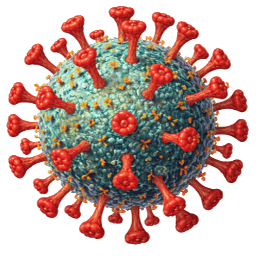
Definition: virus
 A virus is a tiny organism that can reproduce only in living cells. Viruses cause diseases
in humans, animals, and plants.
The flu is caused by a virus.
Fun Facts
1. The word "virus" comes from a Latin word meaning "poison." The name originates from the Latin word virus, which translates to "poisonous liquid," "venom," or "slimy secretion." Before scientists could see them under microscopes, they used the term to describe unknown disease-causing agents!
2. Viruses are not considered fully "alive" by most scientists. Unlike plants, animals, and bacteria, viruses cannot eat, produce energy, or reproduce on their own! They exist as inactive biological packages until they enter a host's living cell, occupying a gray area between living organisms and non-living chemistry.
3. Viruses are thousands of times smaller than a single cell. Viruses are so tiny that you cannot see them under a regular school light microscope! They range in size from 20 to 400 nanometers. To see them, scientists use powerful electron microscopes that use beams of electrons instead of light rays.
4. A basic virus consists of genetic material inside a protein shell. A typical virus structure is surprisingly simple: it consists of a strand of genetic instructions (either DNA or RNA) protected inside a protein coat called a capsid. Some viruses also have an outer spherical layer made of fats called an envelope.
5. Viruses hijack host cells to make millions of copies of themselves. Because viruses lack cell machinery, they must act like microscopic pirates! A virus uses its surface proteins to unlock and enter a host cell, then reprogram the cell's ribosome factories to produce thousands of new virus particles instead of normal cell proteins.
6. Your immune system uses antibodies to block viruses like lock-and-key puzzles. When a virus enters your body, white blood cells produce targeted proteins called antibodies. These antibodies match the specific shape of the virus's outer proteins, locking onto them so the virus cannot attach to healthy cells and signaling scavenger cells to destroy them!
7. There are more viruses on Earth than stars in the entire observable universe. Scientists estimate that there are over 1031 (10 nonillion) individual viruses on Earth! If you lined up every single virus end-to-end, the microscopic chain would stretch for about 100 million light-years across space.