
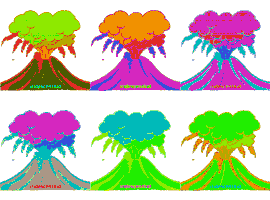
Definition: volcano
 A volcano is a special kind of mountain that acts like a chimney for the Earth's
hot, molten rock (magma) to escape from deep underground. When this hot, red liquid breaks through
to the surface, it is called lava, which cools to form new land. Volcanoes can be active (erupting),
dormant (sleeping), or extinct (finished).
Fun Facts
1. The word "volcano" comes from the Roman god of fire. The word originates from Vulcano, a volcanic island in Italy named after Vulcan, the ancient Roman god of fire, metalworking, and blacksmithing!
2. Liquid rock changes its name from "magma" to "lava" when it surfaces. Beneath the Earth's crust, molten rock is called magma. The moment it breaches an opening in the crust and flows out onto the surface, scientists refer to it as lava!
3. Dissolved gases under pressure trigger explosive volcanic eruptions. Magma contains dissolved gases like water vapor, carbon dioxide, and sulfur dioxide. As magma rises toward a vent, decreasing hydrostatic pressure allows these gas bubbles to expand rapidly—like shaking a warm bottle of soda before popping the cap off!
4. Over 75% of the Earth's active volcanoes sit along the Pacific "Ring of Fire." The Ring of Fire is a 25,000-mile horseshoe-shaped basin in the Pacific Ocean. It is formed by tectonic plate subduction, where ocean plates slide underneath continental plates, melting rock into active volcanic chains.
5. Pumice is a volcanic rock so lightweight that it floats on water. During explosive eruptions, lava filled with high-pressure gas bubbles cools almost instantly in the air. This traps millions of microscopic air pockets inside the hardened rock, creating pumice—an igneous rock with a density low enough to float on water!
6. The largest volcano in the Solar System is on Mars. Olympus Mons on Mars is a giant shield volcano measuring 13 miles (21 km) high—nearly three times taller than Mount Everest! Because Mars has no active plate tectonics, a single hotspot kept spewing lava in the exact same spot for millions of years.
7. Underwater volcanoes create brand-new islands from submarine eruptions. More than 70% of all volcanic eruptions happen under the ocean floor at mid-ocean ridges. As lava erupts into cold seawater, it cools into pillow lava and piles up over time, eventually breaking the ocean surface to form new landmasses like Hawaii and Iceland!