
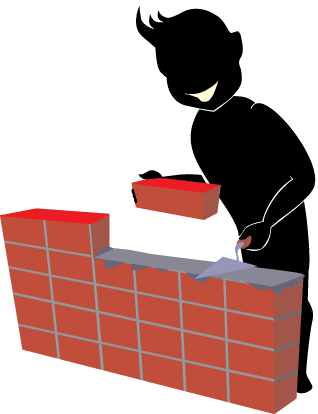
Definition: wall
 A wall is a side of a building or room. Also, walls can be free-standing, like the city walls
that protectected cities in ancient and medieval times.
Fun Facts
1. The word "wall" comes from an ancient Latin word for a rampart. The word originates from the Latin term vallum, which means "an earthen wall, rampart, or palisade." It stems from vallus (meaning "stake" or "post"), referring to the wooden defensive stakes early Roman soldiers drove into dirt mounds around their camps!
2. Ancient builders used sticky rice mortar to make the Great Wall of China indestructible. During the Ming Dynasty, Chinese masons created a revolutionary mortar recipe by mixing slaked lime with amylopectin, the sticky starch found in boiled sticky rice. This organic-inorganic blend created a tight chemical bond that remains so tough that weeds still cannot grow between the stones!
3. Drystone walls stay standing for centuries without using any cement or mortar. Traditional drystone walls are built entirely by interlocking raw, uncarved stones like a giant 3D jigsaw puzzle. Builders rely strictly on gravity, friction, and careful weight distribution, allowing rainwater to drain right through without building up damaging hydrostatic pressure!
4. Load-bearing walls transfer a building's roof weight down to the foundation. In architecture, a load-bearing wall acts as a primary structural support, transferring the gravitational forces of upper floors and roofs down to the earth. In contrast, non-load-bearing "partition walls" (like modern interior drywall) only serve to divide rooms into separate spaces!
5. Drywall uses gypsum plaster sandwiched between heavy sheets of paper. Most modern house walls are made of drywall (also called sheetrock). Inside drywall is a layer of soft mineral gypsum (CaSO4⋅2H2O). Gypsum naturally contains bound water molecules, making drywall inherently fire-resistant because heat must evaporate the trapped water before the board can catch fire!
6. Sea walls disrupt wave energy using curved hydrodynamic shapes. Coastal sea walls protect shorelines from powerful ocean storms. Instead of being completely flat, modern sea walls often feature curved or stepped surfaces designed to redirect the kinetic energy of incoming waves back out to sea, preventing coastal erosion!
7. Soundproof acoustic walls trap noise energy inside porous fibers. Specialist acoustic walls block sound using sound transmission class (STC) engineering. They use dense materials to block air vibrations and soft, porous insulation (like rockwool) to absorb sound waves, converting acoustic energy into microscopic amounts of heat!