
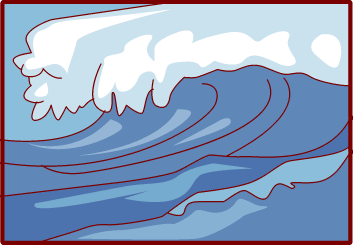
Definition: wave
 A wave is when some of the water in a lake or ocean rises up and moves across the top
of the water, it is called a wave.
Fun Facts
1. The word "wave" comes from an ancient Germanic word for motion. The word originates from the Old English term wāgian, which means "to move to and fro, flutter, or shake." It stems from Proto-Germanic wagōnan, referring to fluid motion across water surfaces!
2. Every wave has a highest point called a crest and a lowest point called a trough. The highest peak of a wave cycle is its crest, while the lowest dip is its trough. The distance between two side-by-side crests measures its wavelength, and the vertical height from trough to crest measures its waveheight!
3. Sound waves require physical matter to travel, so space is completely silent. Sound travels through longitudinal waves that compress air, water, or solid particles. Because space is a vacuum with no matter, sound waves cannot vibrate off anything, making outer space completely silent to human ears!
4. Light waves travel as electromagnetic radiation without needing any medium. Unlike sound waves, light is made of transverse electromagnetic waves. Because electric and magnetic fields sustain each other in a vacuum, sunlight can travel 93 million miles through empty space to warm the Earth!
5. Ocean waves break near shore because friction slows down the bottom. As a deep ocean wave approaches a beach, its bottom edge drags against the shallow seafloor. Friction slows down the lower part of the wave, while the top crest keeps moving fast, causing the wave to top over and break into foam!
6. Tsunamis are triggered by displaced water, not surface wind. Regular sea waves are generated by wind blowing over water friction. In contrast, a tsunami is caused by massive underwater earthquakes or landslides displacing entire vertical columns of water, creating long-period waves that travel across oceans at aircraft speeds!
7. Surfers ride the forward gravitational slope of breaking swell waves. Surfing relies on gravitational acceleration! As an ocean wave steepens near shore, a surfer paddles to match the speed of the wave, allowing gravity to pull their board down the sloping face while hydrodynamic lift keeps the board gliding on the surface!