
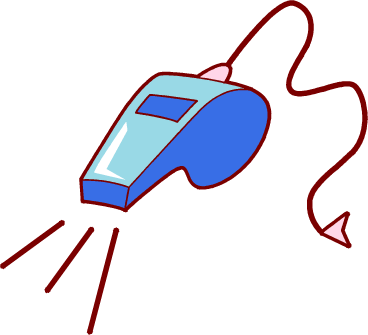
Definition: whistle
 A whistle is a small instrument or pipe that makes a high sound when
you blow air through it. Whistle also refers to the sound the whistle makes.
Fun Facts
1. The word "whistle" comes from an ancient word imitating high-pitched sounds. The word originates from the Old English term hwistlian, which comes from Proto-Germanic khwis (an onomatopoeia simulating the sharp, rushing sound of air moving rapidly through a narrow opening)!
2. Whistles create sound through fluid dynamic instability. When you blow into a whistle, air streams down the mouthpiece and hits a sharp edge called the fipple (or labium). This edge splits the air stream back and forth, creating swirling air pockets called vortices that expand into sound waves!
3. The little rolling ball inside classic whistles is called a "pea." Traditional referee whistles contain a tiny rolling sphere inside the sound chamber. Originally made of dried cork or wood and now made of synthetic plastic, this pea bounces around, interrupting the airflow to create a trilling, warbling sound!
4. Ultrasonic Dog Whistles create sounds humans are physically incapable of hearing. Invented by Francis Galton in 1883, a silent dog whistle emits high frequencies between 23,000 and 54,000 Hertz (Hz). Humans only hear up to 20,000 Hz, but dogs can hear the sound easily thanks to their higher upper auditory range!
5. Steam whistles on ships and trains operate using thermal kinetic pressure. Steam whistles don't rely on human breath! High-pressure steam produced by boilers rushes up a narrow annular slit and strikes the thin rim of a metal bell, converting heat energy and pressure into deafening sonic blasts heard miles away.
6. Ancient civilizations carved carved bone and clay whistles over 30,000 years ago. Archaeologists have uncovered prehistoric flutes and whistles carved from hollow bird bones, mammoth tusks, and baked clay dating back to the Upper Paleolithic era, where they were used for hunting signals and ritual ceremonies!
7. Pealess sports whistles can reach a earsplitting 120 decibels. A hard blow into a high-performance sports whistle produces sound levels up to 120 decibels (dB)—louder than a power lawnmower and nearly as loud as a jet engine taking off! This extreme volume ensures players hear the signal across noisy stadiums.