
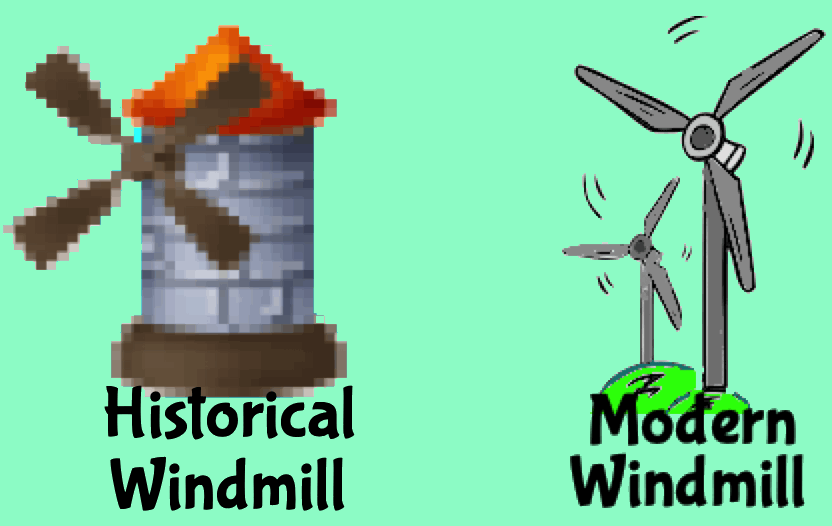
Definition: windmill
 A windmill is a machine that uses energy from the wind to turn a large wheel. Windmills are
used to grind grain into flour, pump water, and make electricity.
Fun Facts
1. The word "windmill" combines two ancient words for blowing air and grinding grain. The word originates from the Old English wind (from Proto-Germanic winda-, "wind") and myln (from the Latin molina, meaning "mill" or "grinding machine"). It literally describes a machine powered by air currents to grind grain!
2. The earliest windmills spun horizontally in ancient Persia. Around 700 AD, Persian engineers built the first recorded windmills using vertical shafts with sails arranged like a carousel. These panemone windmills caught desert winds to grind grain and pump water long before European post mills existed!
3. Windmill blades act like airplane wings using Bernoulli's principle. Modern windmill blades aren't flat paddles pushed by breeze! Instead, they are shaped like airfoils (curved like airplane wings). As wind flows around the blade, low air pressure forms over the curved top, creating aerodynamic lift that forces the blades to spin!
4. American farm windmills used tail vanes for automatic directional control. Invented in 1854 by Daniel Halladay, the multi-bladed farm windmill featured a rear metal tail vane. This vane acted like a rudder, using directional force to pivot the entire wheel frame into the wind to pump groundwater into cattle troughs!
5. Windmills crush grain using friction between carved granite millstones. Inside a traditional mill, grain falls between two massive, circular stones: a stationary bedstone on the bottom and a spinning runner stone on top. Deep radial grooves carved into the stone faces sheer wheat kernels into fine flour as they rub together!
6. Windmill sail positions were used as visual signaling codes across distances. Before telegraphs or telephones existed, Dutch millers tilted their windmill sails into specific resting positions to send long-distance signals to nearby villages, announcing weddings, mourning deaths, or warning of coming storms!
7. Wind turbines convert aerodynamic rotational energy into electricity. Unlike historical windmills that perform direct mechanical work (like grinding flour), modern wind turbines connect the main spinning shaft to an electromagnetic generator, using magnetic induction to generate electric current!