
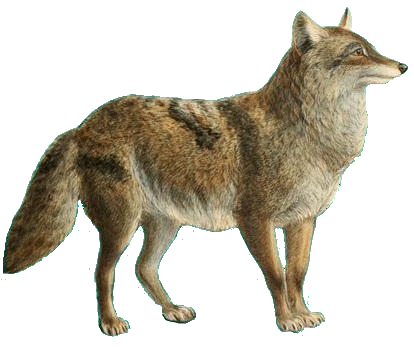
Definition: wolf
 A wolf is a wild mammal that has a pointed nose, pointed ears, and a bushy tail. Wolves
are closely related to coyotes, dogs, and foxes. They usually eat birds and other small animals, but they also
hunt in packs for larger animals such as deer. Wolves used to be common in Europe, Asia, and North America,
but are now extinct or endangered in most areas.
Fun Facts
1. The word "wolf" comes from an ancient Proto-Indo-European root for tearing. The word originates from Old English wulf, which stems from the Proto-Germanic *wulfaz and the ancient Proto-Indo-European root *wl^kwos (meaning "dangerous" or "tearing predator"). It shares etymological lineage with the Latin word lupus!
2. Wolf howls carry up to 10 miles away as long-distance acoustic beacons. A wolf’s howl uses low-frequency sound waves that travel long distances without scattering through dense forests. Wolves howl to coordinate hunting routes with their family, defend territorial boundaries, and locate individual pack members across miles of wilderness!
3. All domestic dogs share a direct evolutionary ancestor with gray wolves. Genetic sequencing reveals that every modern dog breed—from tiny Chihuahuas to giant Great Danes—is a subspecies (Canis lupus familiaris) that diverged from an extinct wild wolf ancestor through domestication between 15,000 and 30,000 years ago!
4. Wolf packs are actually cooperative family units led by parent wolves. Wildlife biologists previously believed packs were held together by aggressive dominance battles for "alpha" status. Field studies of wild wolves proved that natural packs are simple family structures consisting of a breeding mother and father leading their offspring!
5. A wolf's double coat acts as a thermal insulator that repels ice and water. Wolves possess two distinct layers of fur! The dense undercoat traps warm air close to the body, while the longer outer guard hairs shed moisture and block wind. This insulation prevents snow from melting on their fur, keeping heat locked inside!
6. Wolves possess a reflective eye layer that enhances night vision 400 times over humans. Behind a wolf's retina sits a specialized tissue layer called the tapetum lucidum. This mirror-like structure reflects unabsorbed light back through the retina a second time, magnifying visual sensitivity in near-total darkness!
7. A wolf’s sense of smell is roughly 100 times more sensitive than a human's. A wolf’s snout houses over 200 million olfactory receptors (compared to a human's 5 million). They can catch scent particles carried on wind currents over a mile away and track prey animals across days-old trails!