
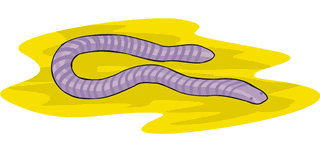
Definition: worm
 A worm is an animal with a long, thin, round or flat body. Worms have no legs and move by creeping
or crawling. Worms are invertebrates and have no backbone.
Fun Facts
1. The word "worm" comes from an ancient Proto-Indo-European root for turning or crawling. The word originates from Old English wyrm (meaning "serpent, dragon, or creeping insect"), which stems from Proto-Germanic *wurmiz and the ancient Proto-Indo-European root *wer- (meaning "to turn, twist, or bend").
2. Earthworms breathe directly through their moist skin via cutaneous respiration. Earthworms do not have lungs! Instead, dissolved oxygen gas passes directly through their thin, mucus-coated skin into their bloodstream through cutaneous respiration. If their skin dries out, they cannot absorb oxygen and will suffocate!
3. Earthworms possess five pairs of heart-like arch pumps. An earthworm doesn't have a single central heart! Instead, it relies on five pairs of muscular blood vessels called aortic arches. These arch structures squeeze rhythmically to pump blood through the dorsal and ventral vessels of its closed circulatory system.
4. Worms crawl using hydraulic pressure and alternating muscle contractions. Worms move through soil using peristalsis! By contracting circular muscles, the worm squeezes its fluid-filled internal body cavity (coelom) to stretch forward. Then, it contracts longitudinal muscles to shorten its tail end, anchored by tiny microscopic bristles called setae.
5. Earthworms are simultaneous hermaphrodites with a reproductive saddle. Every individual earthworm possesses both male and female reproductive organs (simultaneous hermaphroditism)! When two earthworms mate, the swollen band near their front end—called the clitellum—secretes a protective mucous cocoon that shields developing eggs.
6. A worm's ability to regenerate depends on where it is cut. While popular belief claims cutting a worm in half creates two living worms, only the front section containing the head, aortic arches, and nerve rings can survive! If cut past the vital organs, the front half can regenerate a short new tail, but the tail half dies.
7. Darwin spent 40 years studying how earthworms shape global topsoil. Famous biologist Charles Darwin was obsessed with earthworms! In 1881, he published his final scientific book proving that over a few decades, earthworm populations churn millions of tons of subsoil up to the surface, completely reshaping Earth's landscapes!